
How I found my voice at TEDxNormal—and then had to fight to keep It

Updated: Apr 13
My journey to the red dot
For the last 17 years, I’ve stood at the front of classrooms—at Illinois State University and Heartland Community College alike—teaching public speaking. I’ve helped students find their voices, shape their ideas, and stand in front of a room with a little more confidence than they thought they had.

So, when the opportunity to apply for TEDxNormal came along, it didn’t feel random. It felt… aligned. Like something I had been building toward for years without fully realizing it.
I’ve stood on stages before—most notably at That’s What She Said in 2024, where I told a deeply personal story about my father. That kind of speaking asks for vulnerability. It asks you to open something tender and let other people witness it. But TEDx asked something different of me. This wasn’t only about sharing something personal; it was about offering an idea that might shift the way people see themselves and the world around them. Still, I knew the message would only resonate if I rooted it in story. That’s how I know how to reach people—by telling the truth first.
The beginning of something bigger than a talk
When I first got the email in December 2025 that I had been selected as one of nine speakers, I remember pausing. Not because I didn’t believe I could do it—but because I knew what it would require of me.
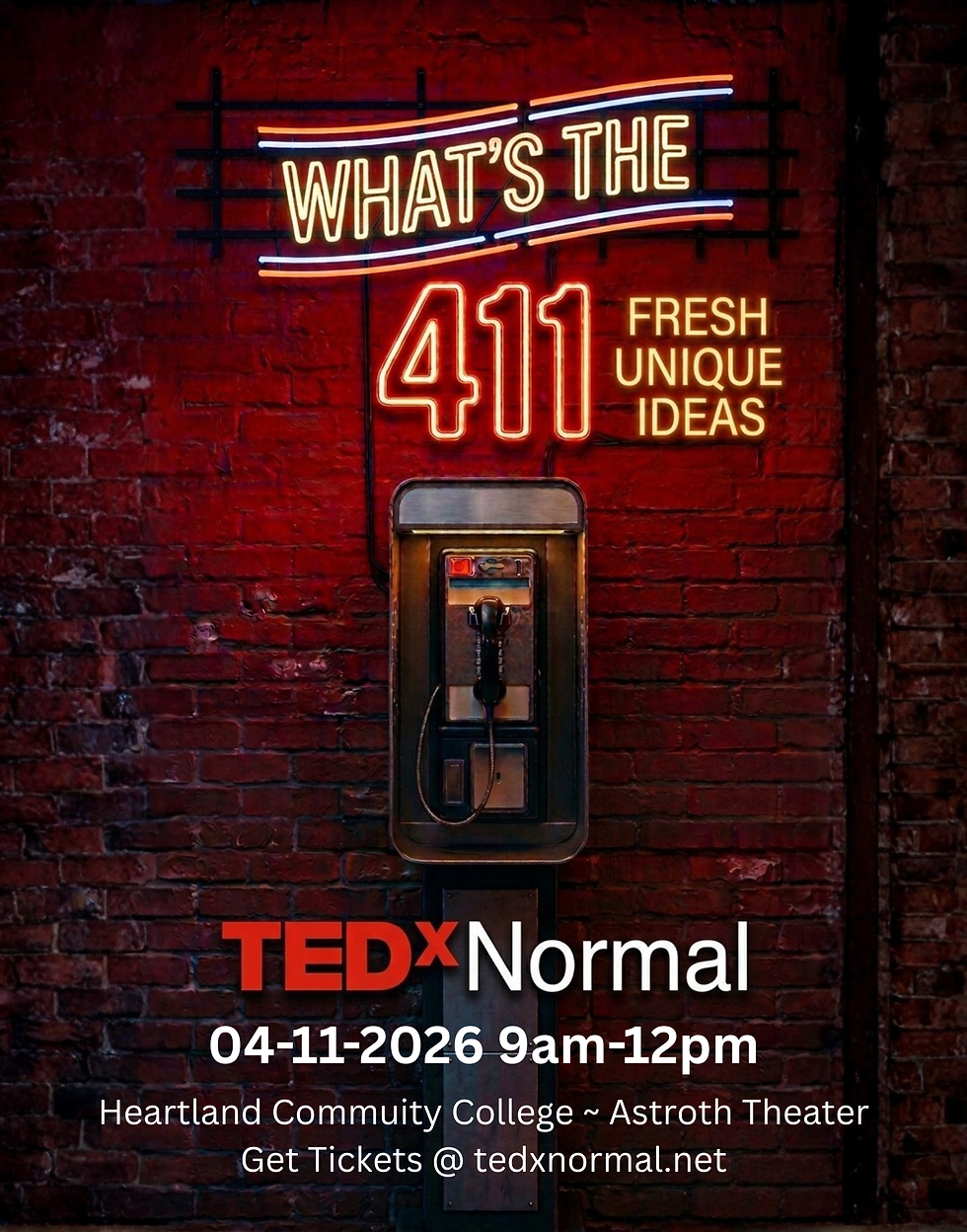
This year’s theme was “What’s the 411?” and the range of topics was as wide as it was powerful—connection, complexity, values, humanity, transformation, advocacy, leadership, agency, and resilience. And somehow, in the middle of all of that, was my story… the silence after the applause.
It’s a story that is deeply personal—one I had already written about, already wrestled with, already come to understand. I knew what I wanted to say. What I hadn’t fully figured out yet was how to say it in a way that carried beyond my own experience—how to shape it into something that could create a shift for the audience.
With my speaker coach, I worked through four drafts—not to discover the story, but to refine it. She helped me bridge the gap between lived experience and larger meaning, guiding me to connect the personal with the purpose behind TEDx. Because the challenge wasn’t just telling a story well. It was telling it in a way that felt honest without being performative, vulnerable without being self-indulgent, and structured in a way that allowed the idea—not just the experience—to land.
When we finally found it, I knew. Not because it was perfect, but because it felt true.
And then came the part I hadn’t fully prepared for: memorizing it. Fifteen minutes. Every word accounted for. Every transition intentional.
The best advice I received was to break the talk into six parts, record myself, and listen to it over and over again until it felt like muscle memory—until it felt like lyrics I could hear in my sleep. So, I did exactly that. I listened while I drove, while I worked, while I moved through the day. Slowly, almost without realizing it, the words stopped feeling like something I had to remember and started feeling like something I knew.
But knowing the words and feeling confident in the experience are not the same thing. And this is the part I think matters most to say out loud:
This journey was not seamless. It was not polished. And it was not always kind.
The friction before the finish line

Because when you’ve worked so hard to build your voice, being asked—directly or indirectly—to soften it, reshape it, or question it… it doesn’t just challenge your performance. It challenges your sense of self.
And that’s exactly why certain moments didn’t just pass—they stayed with me. One in particular has replayed more times than I’d like to admit.
First, though, let me be clear: I welcome feedback. I know how to take it, apply it, and get better because of it—that’s been the foundation of my work as a writer and educator. If there’s something to refine, I’ll find it. If there’s a way to deliver a message more effectively, I’ll do the work to get there.
But some of the feedback I received while preparing didn’t feel like refinement—it felt like a request to become someone else. I was told I “sounded too much like a teacher,” as if nearly two decades in the classroom hadn’t shaped the very voice I bring to a stage. As if that experience was something to strip away, rather than something that gives my voice its clarity and strength. Not to mention its individuality.
And then there was a moment during rehearsal when I was asked if I understood what “vocal inflection” meant. After nearly two decades of teaching public speaking, it wasn’t the question that caught me off guard—it was the assumption behind it. It didn’t just surprise me; it felt dismissive, and if truth be told, a bit insulting. I understood the surface-level intent. What I couldn’t reconcile was why it needed to be asked at all.
And if I’m being completely honest, there was a quieter question underneath it—one I didn’t say out loud in the moment (but definitely whispered later to my friend, Adam) but couldn’t shake: would that question have been asked of me if I were a man? That’s likely a separate conversation—one I’ll save for another day.
But that moment didn’t exist in isolation. There were others—quieter, but just as telling. Like walking into a rehearsal space and not being recognized as a speaker at all.

Instead, it was assumed I was there to support the event as a committee member, not stand at the center of the stage. I brushed it off in the moment, like you do. But those moments have a way of stacking. They settle in. They remind you, subtly but persistently, that sometimes you’re still being measured against expectations you didn’t set. Being underestimated is not a new feeling for me—but that doesn’t mean it stops stinging.
There were also creative choices that felt more personal than they probably appeared on the surface. Photos I had carefully selected—ones that felt meaningful to the story I was telling—were ultimately removed because they weren’t considered “impressive enough.” And while I understood the intent, it was another moment where what mattered to me felt quietly minimized.
And then there were the smaller things—the ones that might seem insignificant on their own but feel heavier when layered on top of everything else. My last name being mispronounced in the introduction. The clicker that didn’t work, leaving me to deliver a talk I had carefully designed with visuals… without them.
Individually, each moment was manageable. Together, they told a story I couldn’t ignore.
The part I’ll hold onto

And yet, when I look back on the experience as a whole, those moments don’t define it. Because there were others—ones that felt expansive and anchoring at the same time.
I found myself building connections I didn’t anticipate—real ones, the kind that form quickly when people are willing to show up honestly. Conversations with other speakers reminded me how many different ways there are to be brave, and somewhere along the way, strangers became friends—the kind you don’t expect to meet but somehow can’t imagine the experience without. (And I can say with complete certainty I will never think about Amish romance—or the image of churning butter—the same way again. The unexpected laughter alone was worth it, Shane!)
Those connections stretched beyond geography, expanding my world in ways I didn’t see coming. And then, the audience. The friends. The family. The people who showed up not just to watch, but to witness.
And my kids. Seeing them in the audience shifted everything for me. It grounded the experience in something deeper than performance. Because as much as I wanted to do well—to deliver the talk I had worked so hard on—what mattered most in that moment was what they saw: their mom on stage, choosing bravery, standing in her (perceived) confidence, and following through on something that once would have felt impossible.
Especially my daughter, Lily. I want her to grow up knowing that her voice matters. That she doesn’t have to shrink herself to fit into a space. That she can walk into a room—even one where she isn’t immediately recognized for who she is—and still choose to stand there anyway.
Standing on that stage, I wasn’t just delivering a talk. I was showing her what it looks like to take up space. To trust your voice. To do something hard, even when it would be easier not to.
For every version of me that stayed small

By the time I stepped onto the red dot, something had shifted—not just in how I delivered the talk, but in how I understood what it meant to stand there at all. Because this was never just about public speaking. It was about becoming someone my younger self might not have recognized at first—and then, slowly, someone she would.
As I walked on stage, I thought about the twelve-year-old version of me who sat quietly in the back of the classroom. The one who was always told she was “too quiet.” The one who was asked, over and over again, why don’t you talk more? The girl whose chest tightened the moment a speech was assigned—who rehearsed every word in her head but couldn’t get them out when it mattered. The one who measured her voice before she ever used it.
Standing on that stage, I realized I wasn’t just speaking for myself. I was standing there for her—for every moment she felt small, for every time she believed silence was safer, for every instance she mistook quiet for a limitation instead of what it really was: the beginning of a voice she simply hadn’t learned to trust yet.
Because what this journey gave me isn’t just a better understanding of public speaking. It gave me a deeper understanding of myself. Of resilience. Of identity. Of the quiet, internal work it takes to decide who you are—and to keep choosing that version of yourself, even when the world around you pushes back.
It taught me that preparation doesn’t guarantee ease—but it creates steadiness. That not all feedback deserves equal weight, and part of growth is learning what to hold onto and what to release. That being underestimated can either diminish you or refine you, depending on how you carry it.

It reminded me that my voice—shaped by years in the classroom, by lived experience, by both confidence and doubt—is not something I need to soften or reshape to be worthy of a stage like this. It is the very reason I belong on it.
And maybe most importantly, it reinforced something I’ve always believed, but now understand in a deeper, more lived way: things will go wrong. Plans will shift. Expectations will fall short. You will find yourself in moments you didn’t anticipate. And you can still show up fully. You can still deliver. You can still stand there—with clarity, with conviction, with presence.
The journey to that stage wasn’t perfect. It wasn’t easy. It asked more of me than I expected. But it gave me something in return that I’ll carry far beyond that moment: a quiet, steady certainty—not just that I can do hard things, but that I don’t have to become someone else to do them.
That the voice I’ve built isn’t something to soften or reshape to fit the room. It’s something to trust. Something to stand in. Because by the time I stepped onto that red dot, I understood something I hadn’t fully named before: this was never about finding my voice. It was about learning to stay true to it—through every version of myself that brought me there.
And when it mattered most—when the lights were on and the room was still—I didn’t just step onto that red dot. I stood there—for the girl who once stayed quiet, for the woman who learned how to speak, and for every version of me in between.
Not a different voice. Not a better one.
Just mine.



Thank you for the honest and important "behind the scenes" and inspiration to stay authentic and use your voice :)